A SegmentOS pricing experiment
There is a reflex right now to put "AI" on everything, and an assumption underneath it: that the label lets you charge more. We tested the assumption. It does the opposite.
The test
We described one meal-planning app to 265 US adults who pay for apps. Two groups, assigned at random, saw the exact same description, with one difference:
Group A: "A meal-planning app that builds you a personalized weekly menu and grocery list."
Group B: "An AI-powered meal-planning app that builds you a personalized weekly menu and grocery list."
Same app. Same features. One word. Then we asked each group the most they would pay per month.
The result
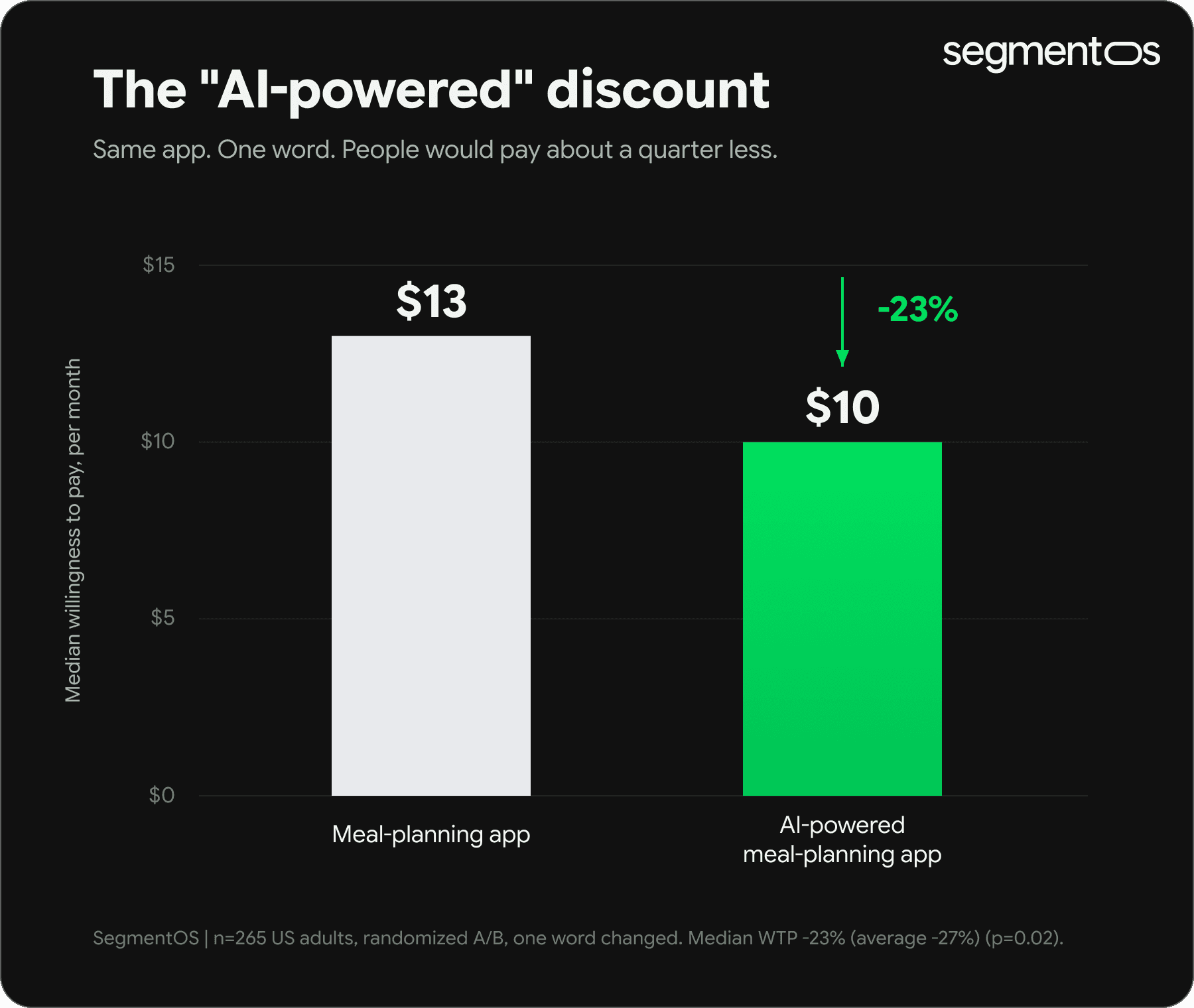
The group that saw "AI-powered" would pay about a quarter less. The typical (median) answer dropped from $13 to $10, and the result was statistically significant (p=0.02). It held on a robust rank test and got stronger, not weaker, when we removed people who rushed the survey.
The part that surprised us
If the story were "people hate AI," you would expect them to trust the AI version less and be less likely to try it. They weren't.
Trust: no meaningful difference (3.23 vs 3.12 out of 5).
Intent to try: no meaningful difference (50% vs 55% likely to download).
So the label did not scare anyone off. People would still use the AI version, and trust it the same. They just valued it less when it came time to pay. "AI-powered" was not a premium. It was a quiet discount.
Why this matters if you are building something
The words on your product are a pricing decision. "AI-powered," "smart," "next-generation," each one moves what a buyer will pay, up or down, and most teams are guessing at which. This test cost one afternoon and 265 people to answer for real. Your version, on your product, in your market, would give you a number you can actually price against.
This is the flip side of our AI Tax Report, where consumers penalized AI in what they chose. Here you can see it land directly on the price.
Build a study, reach verified respondents in your market, and get answers back in days.
Everything a research team does. Without the research team.
With SegmentOS you can build the study, reach a verified audience, and get data you can actually trust. End to end, no research background required.


Data quality
Every study runs through device fingerprinting, speeding detection, attention checks, and screener disqualification.

Method
Two identical studies, 265 US adults who pay for apps, run in parallel with no shared respondents. Willingness to pay is reported as the median ($13 vs $10, a 23% drop) because a few respondents entered implausible figures; the average moved consistently ($23.75 vs $17.31, a 27% drop). Significance tested with a Mann-Whitney rank test (p=0.02), which is robust to those outliers. Trust and intent differences were not statistically significant, and we are not claiming them. Full method available on request.
Cite this: SegmentOS, "The AI-Powered Discount," 2026. https://segmentos.io/blog/ai-powered-pricing-experiment
Want to know what a label, a price, or a claim does to what your market will pay? Run your own pricing study.
Frequently Asked Questions (FAQ)
Does this mean I should drop "AI" from my product?
No. This measured willingness to pay, not whether to use AI. People were just as likely to try the AI version and trusted it the same. The narrow lesson: do not assume the "AI" label lets you charge more. Test the framing before you price around it.
Why would the same app be worth less just because it says "AI-powered"?
We can only show the effect, not the mechanism. One plausible reason: "AI-powered" signals "automated and cheap to run" to a lot of consumers, which anchors them to a lower price, the way "generated" or "self-service" might. Whatever the story, the association is real and measurable.
Can one word really move pricing, or is this just noise?
It is a randomized result, not noise. Both groups saw the identical app and were assigned at random, so the only systematic difference was the word. The gap was statistically significant (p=0.02), and it grew rather than shrank when we removed people who rushed the survey.
Does this apply to my product?
Maybe, maybe not, and that is the real point. This was one everyday consumer app tested on US adults. Your category and buyer could react differently, and some markets genuinely pay a premium for "AI." The only way to know your number is to test your own framing on your own audience.
How do I run this test for my own product?
Describe your product two ways, change one thing (a label, a price, a claim), and show each version to a separate group of your target buyers. Compare what each group would pay. You can build and field it yourself in an afternoon. Run a pricing study.